Research Collaborators These are the people I have written papers with, or helped with theirs; the map is incomplete. If you would like to talk about research, book a quick chat .
Equal Earth projection Amir Abdulgadir — Massachusetts Institute of Technology — Cambridge, US (2025-06–2025-08) Amir Abdulgadir — Howard University — Washington, US (2024–present) Matteo Bachetti — INAF-Osservatorio Astronomico di Cagliari — Selargius, IT (2024-01–present) Matteo Bachetti — INAF-Osservatorio Astronomico di Cagliari — Selargius, IT (2015-12–2023-12); 1 paper together Matteo Bachetti — INAF-Osservatorio Astronomico di Cagliari — Selargius, IT (2014-09–2015-11) Matteo Bachetti — Institut de Recherche en Astrophysique et Planétologie — Toulouse, FR (2011-09–2014-08) Matteo Bachetti — CESR — Toulouse, FR (2011-02–2011-08) Matteo Bachetti — CESR — Toulouse, FR (2010-02–2010-12) Matteo Bachetti — Università degli Studi di Cagliari — Cagliari, IT (2007–2010-02) Médéric Boquien — Université Côte d'Azur — Nice, FR (2023–present) Médéric Boquien — Universidad de Tarapacá — Santiago, CL (2023–2023) Médéric Boquien — Universidad de Antofagasta — Antofagasta, CL (2015–2023); 1 paper together Médéric Boquien — University of Cambridge — Cambridge, GB (2013–2015) Médéric Boquien — Laboratoire d'Astrophysique de Marseille — Marseille, FR (2011–2013) Médéric Boquien — University of Massachusetts Amherst — Amherst, US (2007–2011) Médéric Boquien — University Paris VII — Paris, FR (2004–2007) Médéric Boquien — Université Pierre et Marie Curie — Paris, FR (2003–2004) Jo Bovy — University of Toronto — Toronto, CA (2015-07–present); 4 papers together, 1 assist C. E. Brasseur — Lowell Observatory — Flagstaff, US (2025-10–present) C. E. Brasseur — University of St Andrews — St Andrews, GB (2021-10–2025-06); 1 paper together C. E. Brasseur — Liverpool John Moores University — Liverpool, GB (2017-09–2019-10) C. E. Brasseur — Space Telescope Science Institute — Baltimore, US (2016-05–2021-08) C. E. Brasseur — Mills College — Oakland, US (2008-08–2010-05) C. E. Brasseur — Oberlin College — Oberlin, US (2004-08–2008-05) Daniela Calvetti — Case Western Reserve University — Cleveland, US (1997-08–present); 1 paper together Yingtian Chen — The Ohio State University — Columbus, US (2026-10–present) Yingtian Chen — University of Michigan — Ann Arbor, US (2020-09–2026-08); 1 assist Yingtian Chen — Massachusetts Institute of Technology — Cambridge, US (2019-07–2019-08) Yingtian Chen — Peking University — Beijing, CN (2016-09–2020-07) Yingtian Chen — Chengdu Experimental Foreign Languages School — Chengdu, CN (2010-09–2016-07) Lia Corrales — University of Michigan — Ann Arbor, US (2020-09–present); 1 paper together Lia Corrales — University of Michigan — Ann Arbor, US (2018-09–2020-08) Lia Corrales — University of Wisconsin Madison — Madison, US (2016-09–2018-08) Lia Corrales — Massachusetts Institute of Technology — Cambridge, US (2014-07–2016-08) Lia Corrales — Columbia University — New York, US (2007-09–2014-06) Lia Corrales — Harvey Mudd College — Claremont, US (2002-09–2006-05) Kelle L. Cruz — Hunter College — New York, US (2017-09–present); 1 paper together Kelle L. Cruz — Hunter College — New York, US (2010-01–2017-08) Kelle L. Cruz — University of Pennsylvania — Philadelphia, US (2000-09–2004-05) Kelle L. Cruz — University of Pennsylvania — Philadelphia, US (1996-09–2000-05) Elliot Y. Davies — Massachusetts Institute of Technology — Cambridge, US (2025-09–present); 1 paper together Elliot Y. Davies — University of Cambridge — Cambridge, GB (2021-10–2025-06) Elliot Y. Davies — The University of Edinburgh — Edinburgh, GB (2020-09–2021-08) Elliot Y. Davies — Princeton University — Princeton, US (2016-09–2020-06) Axel Donath — Center for Astrophysics Harvard & Smithsonian — Cambridge, US (2021-10–present); 1 paper together Axel Donath — Max-Planck-Institut für Kernphysik — Heidelberg, DE (2018-06–2021-10) Axel Donath — Ruprecht Karls Universität Heidelberg — Heidelberg, DE (2014–2018) Axel Donath — Ruprecht Karls Universität Heidelberg — Heidelberg, DE (2011–2014) Axel Donath — Ruprecht Karls Universität Heidelberg — Heidelberg, DE (2007–2011) Dylan Folsom — Princeton University — Princeton, US (2020-08–present); 1 paper together Dylan Folsom — Vanderbilt University — Nashville, US (2016-08–2020-06) Adam Ginsburg — University of Florida — Gainesville, US (2023-08–present) Adam Ginsburg — University of Florida — Gainesville, US (2019-08–2023-08); 1 paper together Adam Ginsburg — University of Colorado — Boulder, US (2007-08–2013-09) Adam Ginsburg — University of Colorado — Boulder, US (2007–2009) Adam Ginsburg — Rice University — Houston, US (2003-08–2006-05) Oleg Y. Gnedin — University of Michigan — Ann Arbor, US (2006-09–present); 1 assist Jenny E. Greene — Harvard University — Cambridge, US (2001-09–2006-05) Jenny E. Greene — Yale University — New Haven, US (1996-09–2000-06) Matt J. Jarvis — University of Oxford — Oxford, GB (2014-08–present); 1 assist Matt J. Jarvis — University of Oxford — Oxford, GB (2012-10–2014-07) Matt J. Jarvis — University of Hertfordshire — Hatfield, GB (2009-04–2012-09) Matt J. Jarvis — University of Hertfordshire — Hatfield, GB (2007-01–2009-04) Matt J. Jarvis — University of Oxford — Oxford, GB (2002-12–2006-12) Matt J. Jarvis — Leiden University — Leiden, NL (2000-10–2002-11) Matt J. Jarvis — University of Oxford — Oxford, GB (1997-10–2000-09) Matt J. Jarvis — University of Birmingham — Birmingham, GB (1993-09–1997-06) Kathryn V. Johnston — Columbia University — New York, US (2006-07–present); 1 paper together Taisiia Karasova — Massachusetts Institute of Technology — Cambridge, US (2025–2026) Wolfgang E. Kerzendorf — Michigan State University — East Lansing, US (2019-08–present); 1 paper together Wolfgang E. Kerzendorf — Michigan State University — East Lansing, US (2019-08–present); 1 paper together Wolfgang E. Kerzendorf — New York University — New York, US (2019-01–2019-08) Wolfgang E. Kerzendorf — European Southern Observatory — Garching bei Muenchen, DE (2014-12–2018-11) Wolfgang E. Kerzendorf — University of Toronto — Toronto, CA (2011-10–2014-09) Wolfgang E. Kerzendorf — ANU Research School of Astronomy and Astrophysics — Weston Creek, AU (2007-02–2011-12) Wolfgang E. Kerzendorf — Ruprecht Karls Universität Heidelberg — Heidelberg, DE (2002-10–2006-10) Arthur Kosowsky — University of Pittsburgh — Pittsburgh, US (2012-09–present); 1 paper together Arthur Kosowsky — University of Pittsburgh — Pittsburgh, US (2005-09–2012-08) Arthur Kosowsky — Rutgers University — New Brunswick, US (2004-09–2005-08) Arthur Kosowsky — Rutgers University — New Brunswick, US (1997-09–2004-08) Arthur Kosowsky — Harvard University — Cambridge, US (1994-09–1997-08) F. Lelli — Arcetri Astrophysical Observatory (INAF) — Florence, IT (2020-12–present) F. Lelli — Cardiff University — Cardiff, GB (2020-01–2020-12) F. Lelli — European Southern Observatory — Garching bei Muenchen, DE (2017-01–2019-12); 2 papers together F. Lelli — Case Western Reserve University — Cleveland, US (2014-01–2016-12) F. Lelli — University of Groningen — Groningen, NL (2009-12–2013-12) F. Lelli — University of Bologna — Bologna, IT (2006-10–2009-10) F. Lelli — University of Bologna — Bologna, IT (2003-10–2006-10) P. Li — Nanjing University — Nanjing, CN (2024-03–present) P. Li — Leibniz Institute for Astrophysics Potsdam — Potsdam, DE (2022-02–2024-01) P. Li — Goethe Institut — Berlin, DE (2021-11–2022-02) P. Li — Case Western Reserve University — Cleveland, US (2020-09–2021-11) P. Li — Case Western Reserve University — Cleveland, US (2016-05–2020-08); 1 paper together Pey Lian Lim — Space Telescope Science Institute — Baltimore, US (2007-10–present); 1 paper together Zihan Liu — Cornell University — Ithaca, US (2026–present) F. R. Marleau — Universität Innsbruck — Innsbruck, AT (2012–2025) S. S. McGaugh — Case Western Reserve University — Cleveland, US (2012-08–present); 2 papers together S. S. McGaugh — University of Maryland — College Park, US (1998-07–2012-08) S. S. McGaugh — Rutgers The State University of New Jersey — New Brunswick, US (1997-11–1998-06) S. S. McGaugh — Carnegie Institution for Science — Washington, US (1995-09–1997-10) S. S. McGaugh — University of Cambridge — Cambridge, GB (1992-10–1995-09) S. S. McGaugh — University of Michigan — Ann Arbor, US (1987-07–1992-06) S. S. McGaugh — Princeton University — Princeton, US (1985-09–1986-08) S. S. McGaugh — Massachusetts Institute of Technology — Cambridge, US (1981-09–1985-05) Connor McKeigan — University of Toronto — Toronto, CA (2023–2025) Brett M. Morris — Space Telescope Science Institute — Baltimore, US (2026-04–present) Brett M. Morris — Space Telescope Science Institute — Baltimore, US (2022-09–2026-03) Brett M. Morris — Universität Bern — Bern, CH (2019-07–2022-08); 1 paper together Brett M. Morris — University of Washington — Seattle, US (2013-09–2019-04) Brett M. Morris — University of Washington — Seattle, US (2013-08–2015-08) Brett M. Morris — NASA — Washington, US (2013-01–2013-08) Brett M. Morris — University of Maryland — College Park, US (2009-08–2012-12) Charlotte Myers — Massachusetts Institute of Technology — Cambridge, US (2023-09–2027-05); 2 papers together Lina Necib — Massachusetts Institute of Technology — Cambridge, US (2026-07–present); 1 paper together Lina Necib — Massachusetts Institute of Technology — Cambridge, US (2021-07–2026-06); 4 papers together Lina Necib — Observatories of the Carnegie Institution of Washington — Pasadena, US (2020-10–2021-08) Lina Necib — California Institute of Technology — Pasadena, US (2017-09–2020-06) Jacob Nibauer — University of Pennsylvania — Philadelphia, US (2017-06–present); 8 papers together, 2 assists Aarya A. Patil — Max Planck Institute for Astronomy — Heidelberg, DE (2023–present) Aarya A. Patil — University of Toronto — Toronto, CA (2018–2023); 1 paper together Aarya A. Patil — Savitribai Phule Pune University — Pune, IN (2014–2018) Sarah Pearson — Technical University of Denmark — Kongens Lyngby, DK (2026-05–present); 4 papers together, 1 assist Sarah Pearson — University of Copenhagen — Copenhagen, DK (2023-12–present); 4 papers together, 1 assist Sarah Pearson — New York University — New York, US (2020-12–2023-12) Sarah Pearson — Center for Computational Astrophysics — NYC, US (2018-08–2020-12) Sarah Pearson — Columbia University — New York, US (2013-09–2018-06) Timothy E. Pickering — University of Arizona — Tucson, US (2017-01–present); 1 paper together Timothy E. Pickering — Space Telescope Science Institute — Baltimore, US (2013-08–2016-12) Timothy E. Pickering — Southern African Large Telescope — Observatory, ZA (2009-10–2013-07) Timothy E. Pickering — MMT Observatory — Tucson, US (2001-08–2009-09) Timothy E. Pickering — University of Arizona — Tucson, US (2000-09–2001-08) Timothy E. Pickering — University of Arizona — Tucson, US (1992-08–1998-08) Timothy E. Pickering — Universtity of Wisconsin — Madison, US (1988-09–1992-07) Adrian M. Price-Whelan — Simons Foundation — New York, US (2025-10–present); 1 paper together, 1 assist Adrian M. Price-Whelan — Simons Foundation — New York, US (2021-08–2025-10); 4 papers together, 1 assist Adrian M. Price-Whelan — Simons Foundation — New York, US (2019-07–2021-08) Adrian M. Price-Whelan — Princeton University — Princeton, US (2016-07–2019-07) Adrian M. Price-Whelan — Columbia University — New York, US (2011-09–2016-05) J. M. Schombert — Univ. of Oregon — Eugene, US (1996–2018) J. M. Schombert — NASA — Washington, US (1994–1996) J. M. Schombert — Caltech — Pasadena, US (1991–1994) J. M. Schombert — University of Michigan — Ann Arbor, US (1988–1991) J. M. Schombert — California Institute of Technology — Pasadena, US (1984-09–1988-07) J. M. Schombert — Yale University — New Haven, US (1980–1984) Jack Setford — University of Toronto — Toronto, CA (2018-09–present); 1 assist Jack Setford — University of Sussex — Brighton, GB (2014-09–2018-06) Jack Setford — University of Oxford — Oxford, GB (2010-09–2014-07) Albert Y. Shih — NASA — Washington, US (2010–present); 1 paper together Albert Y. Shih — University of California, Berkeley — Berkeley, US (2001–2009) Albert Y. Shih — California Institute of Technology — Pasadena, US (1997–2001) David L. Shupe — Caltech — Pasadena, US (1995-05–present); 1 paper together Brigitta M. Sipőcz — California Institute of Technology — Pasadena, US (2021–present); 1 paper together Brigitta M. Sipőcz — University of Washington — Seattle, US (2018–2021) Erkki Somersalo — Case Western Reserve University — Cleveland, US (2008-08–present); 1 paper together Erkki Somersalo — University of Helsinki — Helsinki, FI (1986-09–present); 1 paper together David N. Spergel — Simons Foundation — New York, US (2017-08–present); 1 paper together, 1 assist Glenn Starkman — Case Western Reserve University — Cleveland, US (1995-01–present); 2 papers together Glenn Starkman — Canadian Institute for Advanced Research — Toronto, CA (1994-01–1994-12) Glenn Starkman — Canadian Institute for Theoretical Astrophysics — Toronto, CA (1991-07–1994-12) Glenn Starkman — Institute for Advanced Study — Princeton, US (1988-07–1991-06) Glenn Starkman — Stanford University — Palo Alto, US (1984-09–1988-06) Glenn Starkman — University of Toronto — Toronto, CA (1980-09–1984-06) Nathaniel Starkman — MIT — Cambridge, US (2024-10–present); 14 papers together Nathaniel Starkman — Case Western Reserve University — Cleveland, US (2024–2027); 15 papers together Nathaniel Starkman — University of Toronto — Toronto, CA (2018-09–2024-08); 6 papers together Nathaniel Starkman — University of Toronto — Toronto, CA (2018-09–2024-09); 6 papers together Nathaniel Starkman — Case Western Reserve University — Cleveland, US (2017-05–2018-05); 1 paper together Nathaniel Starkman — CLASSE REU — Ithaca, US (2016-05–2016-08) Nathaniel Starkman — Prof. John Ruhl, South Pole Telescope — Cleveland, US (2015-05–2015-08) Nathaniel Starkman — Case Western Reserve University — Cleveland, US (2014-08–2018-05); 1 paper together Nathaniel Starkman — European Organization for Nuclear Research — Geneve, CH (2012-08–2013-08) John D. Swinbank — Netherlands Institute for Radio Astronomy — Dwingeloo, NL (2020-10–present); 1 paper together John D. Swinbank — University of Washington — Seattle, US (2017-10–2020-09) John D. Swinbank — Princeton University — Princeton, US (2014-10–2017-09) John D. Swinbank — University of Amsterdam — Amsterdam, NL (2006-10–2014-09) John D. Swinbank — University of Oxford — Oxford, GB (2002-10–2006-09) John D. Swinbank — University of Oxford — Oxford, GB (1998-10–2002-06) Kiyan Tavangar — Columbia University — New York, US (2022-09–present); 1 paper together, 1 assist Kiyan Tavangar — Columbia University — New York, US (2022-09–present); 1 paper together, 1 assist Kiyan Tavangar — Flatiron Institute — New York, US (2021-09–2022-06) Kiyan Tavangar — The University of Chicago — Chicago, US (2017-09–2021-06) Nicolas Tessore — University College London — London, GB (2025-08–present) Nicolas Tessore — University College London — London, GB (2021-08–2025-07) Nicolas Tessore — University College London — London, GB (2020-10–2021-07) Nicolas Tessore — University of Manchester — Manchester, GB (2016-04–2020-10) Nicolas Tessore — Università di Bologna — Bologna, IT (2015-10–2016-03) Nicolas Tessore — Università di Bologna — Bologna, IT (2012-10–2015-12) Nicolas Tessore — Ruprecht Karls Universität Heidelberg — Heidelberg, DE (2006-09–2012-05) Andreas Thoyas — Northeastern University — Boston, US (2023-09–2027-05); 1 paper together James Tocknell — Macquarie University — Macquarie Park, AU (2013-10–present); 1 paper together James Tocknell — Macquarie University — Macquarie Park, AU (2009-01–2012-12) Grant R. Tremblay — Smithsonian Astrophysical Observatory — MA, US (2017-07–present); 1 paper together Grant R. Tremblay — Yale University — New Haven, US (2014-09–2017-07) Grant R. Tremblay — European Southern Observatory — Garching bei Muenchen, DE (2011-09–2014-08) Grant R. Tremblay — Rochester Institute of Technology — Rochester, US (2008-09–2011-05) Grant R. Tremblay — Space Telescope Science Institute — Baltimore, US (2006-09–2008-08) Grant R. Tremblay — University of Rochester — Rochester, US (2002-08–2006-05) Eero Vaher — Lund Observatory — Lund, SE (2019-09–present); 1 paper together Eero Vaher — European Space Agency — Noordwijk, NL (2018–2019) Eero Vaher — Leiden University — Leiden, NL (2016-02–2018-01) Eero Vaher — University of Tartu — Tartu, EE (2011-09–2015-06) Monica Valluri — University of Michigan — Ann Arbor, US (2021-09–2025-05); 1 assist Monica Valluri — University of Michigan — Ann Arbor, US (2017-09–present); 1 assist Monica Valluri — University of Michigan — Ann Arbor, US (2011-09–2017-08) Monica Valluri — University of Michigan — Ann Arbor, US (2007-08–2011-09) Monica Valluri — University of Chicago — Chicago, US (2002-04–2007-07) Monica Valluri — University of Chicago — Chicago, US (2001–2007) Monica Valluri — University of Chicago — Chicago, US (1999–2001) Monica Valluri — Rutgers University — New Brunswick, US (1996–1999) Monica Valluri — Columbia University — New York, US (1994–1996) Monica Valluri — Indian Institute of Science — Bangalore, IN (1987-08–1993-12) Monica Valluri — Birla Institute of Technology and Science — Pilani, IN (1983-08–1987-06) Marten H. van Kerkwijk — University of Toronto — Toronto, CA (2003-01–present); 1 paper together M. Walmsley — University of Toronto — Toronto, CA (2023-09–2025-10) M. Walmsley — University of Manchester — Manchester, GB (2021-02–2023-08) Jeremy Webb — University of Toronto — Toronto, CA (2019-08–present); 3 papers together Harrison Winch — University of Toronto — Toronto, CA (2024-07–2025-06) Harrison Winch — University of Toronto — Toronto, CA (2018-09–2024-07); 1 paper together, 1 assist Sirui Wu — University of Copenhagen — Copenhagen, DK (2024–present); 4 papers together Sirui Wu — Sun Yat-sen University — Guangzhou, CN (2021-09–2024-06) Sirui Wu — Lanzhou University — Lanzhou, CN (2017-09–2021-06) + − ⤢
Show Everyone Mentees ────────── Abdulgadir, Amir Bachetti, Matteo Boquien, Médéric Bovy, Jo Brasseur, C. E. Calvetti, Daniela Chen, Yingtian Corrales, Lia Cruz, Kelle L. Davies, Elliot Y. Donath, Axel Folsom, Dylan Ginsburg, Adam Gnedin, Oleg Y. Greene, Jenny E. Hamraz, Reem Jarvis, Matt J. Johnston, Kathryn V. Karasova, Taisiia Kerzendorf, Wolfgang E. Kosowsky, Arthur Lelli, F. Li, P. Lim, Pey Lian Liu, Zihan Marleau, F. R. McGaugh, S. S. McKeigan, Connor Mercader-Perez, Pablo Morris, Brett M. Myers, Charlotte Necib, Lina Nibauer, Jacob Patil, Aarya A. Pearson, Sarah Pickering, Timothy E. Price-Whelan, Adrian M. Schombert, J. M. Setford, Jack Shih, Albert Y. Shupe, David L. Sipőcz, Brigitta M. Somersalo, Erkki Spergel, David N. Starkman, Glenn Starkman, Nathaniel Swinbank, John D. Tavangar, Kiyan Tessore, Nicolas Thoyas, Andreas Tocknell, James Tremblay, Grant R. Vaher, Eero Valluri, Monica van Kerkwijk, Marten H. Walmsley, M. Webb, Jeremy Winch, Harrison Wu, Sirui May be incomplete / wrong
2025-06–2025-08 Massachusetts Institute of Technology, Cambridge, US Summer research student
2024–present Howard University, Washington, US Undergraduate, Astrophysics
Amir weighs the dark matter of other galaxies with the stellar streams around them.
Constraining Dark Matter in External Galaxies Using Stellar Streams 2025 NSBP-NSHP Joint Annual Conference, November 19–23 Leadership Alliance National Symposium, July 23–25 Full profile → 2024-01–present INAF-Osservatorio Astronomico di Cagliari, Selargius, IT Primo ricercatore (Senior Researcher)
2015-12–2023-12 INAF-Osservatorio Astronomico di Cagliari, Selargius, IT Ricercatore (Staff scientist)
2014-09–2015-11 INAF-Osservatorio Astronomico di Cagliari, Selargius, IT Post-Doc
2011-09–2014-08 Institut de Recherche en Astrophysique et Planétologie, Toulouse, FR Post-Doc
2011-02–2011-08 CESR, Toulouse, FR Software Developer
2010-02–2010-12 CESR, Toulouse, FR Internship/Post Doc
2007–2010-02 Università degli Studi di Cagliari, Cagliari, IT Ph.D.
2023–present Université Côte d'Azur, Nice, FR Professeur des Universités (full professor)
2023–2023 Universidad de Tarapacá, Santiago, CL
2015–2023 Universidad de Antofagasta, Antofagasta, CL Faculty
2013–2015 University of Cambridge, Cambridge, GB post-doctoral researcher
2011–2013 Laboratoire d'Astrophysique de Marseille, Marseille, FR post-doctoral researcher
2007–2011 University of Massachusetts Amherst, Amherst, US post-doctoral researcher
2004–2007 University Paris VII, Paris, FR Doctorate
2003–2004 Université Pierre et Marie Curie, Paris, FR DEA
2015-07–present University of Toronto, Toronto, CA Professor
2025-10–present Lowell Observatory, Flagstaff, US NST Postdoctoral Fellow
2021-10–2025-06 University of St Andrews, St Andrews, GB PhD
2017-09–2019-10 Liverpool John Moores University, Liverpool, GB MSc with distinction
2016-05–2021-08 Space Telescope Science Institute, Baltimore, US Software Engineer
2008-08–2010-05 Mills College, Oakland, US M.A.
2004-08–2008-05 Oberlin College, Oberlin, US B.A.
1997-08–present Case Western Reserve University, Cleveland, US Professor
2026-10–present The Ohio State University, Columbus, US Postdoctoral Researcher
2020-09–2026-08 University of Michigan, Ann Arbor, US Ph.D. candidate
2019-07–2019-08 Massachusetts Institute of Technology, Cambridge, US Visiting Researcher
2016-09–2020-07 Peking University, Beijing, CN B. S. in Physics
2010-09–2016-07 Chengdu Experimental Foreign Languages School, Chengdu, CN Middle & High School
2020-09–present University of Michigan, Ann Arbor, US Assistant Professor
2018-09–2020-08 University of Michigan, Ann Arbor, US LSA Collegiate Fellow
2016-09–2018-08 University of Wisconsin Madison, Madison, US Einstein Fellow
2014-07–2016-08 Massachusetts Institute of Technology, Cambridge, US Postdoctoral Associate
2007-09–2014-06 Columbia University, New York, US Ph.D.
2002-09–2006-05 Harvey Mudd College, Claremont, US B. S.
2017-09–present Hunter College, New York, US Associate Professor
2010-01–2017-08 Hunter College, New York, US Assistant Professor
2000-09–2004-05 University of Pennsylvania, Philadelphia, US PhD
1996-09–2000-05 University of Pennsylvania, Philadelphia, US BA
2025-09–present Massachusetts Institute of Technology, Cambridge, US Postdoctoral Research Associate
2021-10–2025-06 University of Cambridge, Cambridge, GB PhD Astronomy
2020-09–2021-08 The University of Edinburgh, Edinburgh, GB MSc Theoretical Physics
2016-09–2020-06 Princeton University, Princeton, US A.B. Astrophysics with Applied and Computational Mathematics
2021-10–present Center for Astrophysics Harvard & Smithsonian, Cambridge, US Postdoc Researcher
2018-06–2021-10 Max-Planck-Institut für Kernphysik, Heidelberg, DE
2014–2018 Ruprecht Karls Universität Heidelberg, Heidelberg, DE PhD
2011–2014 Ruprecht Karls Universität Heidelberg, Heidelberg, DE M.Sc.
2007–2011 Ruprecht Karls Universität Heidelberg, Heidelberg, DE B.Sc.
2020-08–present Princeton University, Princeton, US Ph.D.
2016-08–2020-06 Vanderbilt University, Nashville, US BA
2023-08–present University of Florida, Gainesville, US Associate Professor
2019-08–2023-08 University of Florida, Gainesville, US Assistant Professor
2007-08–2013-09 University of Colorado, Boulder, US
2007–2009 University of Colorado, Boulder, US MS Astrophysics
2003-08–2006-05 Rice University, Houston, US BS
2006-09–present University of Michigan, Ann Arbor, US
2001-09–2006-05 Harvard University, Cambridge, US PhD
1996-09–2000-06 Yale University, New Haven, US Bachelor of Science
Also 1 paper together, 1 assist, from when their ORCID record names no post.
2014-08–present University of Oxford, Oxford, GB Professor of Astrophysics and Fellow of St. Cross College
2012-10–2014-07 University of Oxford, Oxford, GB University Lecturer and Fellow of St. Cross College
2009-04–2012-09 University of Hertfordshire, Hatfield, GB Reader in Astrophysics
2007-01–2009-04 University of Hertfordshire, Hatfield, GB Senior Lecturer & RCUK Academic Fellow
2002-12–2006-12 University of Oxford, Oxford, GB Postdoctoral Researcher
2000-10–2002-11 Leiden University, Leiden, NL Postdoctoral Research Fellow
1997-10–2000-09 University of Oxford, Oxford, GB DPhil in Astrophysics
1993-09–1997-06 University of Birmingham, Birmingham, GB MPhys in Physics with Astrophysics
2006-07–present Columbia University, New York, US Professor
2025–2026 Massachusetts Institute of Technology, Cambridge, US Undergraduate researcher
2019-08–present Michigan State University, East Lansing, US Assistant Professor
2019-08–present Michigan State University, East Lansing, US Assistant Professor
2019-01–2019-08 New York University, New York, US Senior Research Associate
2014-12–2018-11 European Southern Observatory, Garching bei Muenchen, DE ESO Fellow
2011-10–2014-09 University of Toronto, Toronto, CA Postdoctoral Fellow
2007-02–2011-12 ANU Research School of Astronomy and Astrophysics, Weston Creek, AU PhD
2002-10–2006-10 Ruprecht Karls Universität Heidelberg, Heidelberg, DE Vordiplom
2012-09–present University of Pittsburgh, Pittsburgh, US Professor
2005-09–2012-08 University of Pittsburgh, Pittsburgh, US Associate Professor
2004-09–2005-08 Rutgers University, New Brunswick, US Associate Professor
1997-09–2004-08 Rutgers University, New Brunswick, US Assistant Professor
1994-09–1997-08 Harvard University, Cambridge, US Junior Fellow
2020-12–present Arcetri Astrophysical Observatory (INAF), Florence, IT Research Staff
2020-01–2020-12 Cardiff University, Cardiff, GB Research Associate
2017-01–2019-12 European Southern Observatory, Garching bei Muenchen, DE ESO Fellow
2014-01–2016-12 Case Western Reserve University, Cleveland, US Postdoctoral Scholar
2009-12–2013-12 University of Groningen, Groningen, NL Ph.D. Degree in Astronomy
2006-10–2009-10 University of Bologna, Bologna, IT Master Degree in Astrophysics and Cosmology
2003-10–2006-10 University of Bologna, Bologna, IT Bachelor Degree in Astronomy
2024-03–present Nanjing University, Nanjing, CN Assistant professor
2022-02–2024-01 Leibniz Institute for Astrophysics Potsdam, Potsdam, DE Alexander von Humboldt fellow
2021-11–2022-02 Goethe Institut, Berlin, DE Learning German (sponsored by Alexander von Humboldt foundation)
2020-09–2021-11 Case Western Reserve University, Cleveland, US Postdoctoral scholar
2016-05–2020-08 Case Western Reserve University, Cleveland, US PhD
2007-10–present Space Telescope Science Institute, Baltimore, US
2026–present Cornell University, Ithaca, US PhD student
2012–2025 Universität Innsbruck, Innsbruck, AT Associate Professor
Also 1 paper together, from when their ORCID record names no post.
2012-08–present Case Western Reserve University, Cleveland, US Professor
1998-07–2012-08 University of Maryland, College Park, US Professor
1997-11–1998-06 Rutgers The State University of New Jersey, New Brunswick, US Research Fellow
1995-09–1997-10 Carnegie Institution for Science, Washington, US Carnegie Fellow
1992-10–1995-09 University of Cambridge, Cambridge, GB Research Associate
1987-07–1992-06 University of Michigan, Ann Arbor, US Ph.D.
1985-09–1986-08 Princeton University, Princeton, US
1981-09–1985-05 Massachusetts Institute of Technology, Cambridge, US S.B.
2023–2025 University of Toronto, Toronto, CA Undergraduate thesis student
2026-04–present Space Telescope Science Institute, Baltimore, US Senior Astronomical Data Scientist
2022-09–2026-03 Space Telescope Science Institute, Baltimore, US Senior Software Engineer
2019-07–2022-08 Universität Bern, Bern, CH Postdoctoral research fellow
2013-09–2019-04 University of Washington, Seattle, US PhD
2013-08–2015-08 University of Washington, Seattle, US M. Sc.
2013-01–2013-08 NASA, Washington, US Research Associate
2009-08–2012-12 University of Maryland, College Park, US Bachelor of Science
2023-09–2027-05 Massachusetts Institute of Technology, Cambridge, US
Barry Goldwater Scholarship Three from MIT named 2026 Goldwater Scholars Full profile → 2026-07–present Massachusetts Institute of Technology, Cambridge, US Associate Professor
2021-07–2026-06 Massachusetts Institute of Technology, Cambridge, US Assistant Professor
2020-10–2021-08 Observatories of the Carnegie Institution of Washington, Pasadena, US
2017-09–2020-06 California Institute of Technology, Pasadena, US Postdoctoral Fellow
2017-06–present University of Pennsylvania, Philadelphia, US
2023–present Max Planck Institute for Astronomy, Heidelberg, DE LSST Discovery Alliance Catalyst Fellow
2018–2023 University of Toronto, Toronto, CA PhD
2014–2018 Savitribai Phule Pune University, Pune, IN B.E.
2026-05–present Technical University of Denmark, Kongens Lyngby, DK Associate Professor
2023-12–present University of Copenhagen, Copenhagen, DK Assistant Professor
2020-12–2023-12 New York University, New York, US NASA Hubble Fellow
2018-08–2020-12 Center for Computational Astrophysics, NYC, US Flatiron Research Fellow
2013-09–2018-06 Columbia University, New York, US PhD
2017-01–present University of Arizona, Tucson, US Assistant Staff Scientist
2013-08–2016-12 Space Telescope Science Institute, Baltimore, US Systems Software Engineer
2009-10–2013-07 Southern African Large Telescope, Observatory, ZA SALT Astronomer
2001-08–2009-09 MMT Observatory, Tucson, US Assistant/Associate Staff Scientist
2000-09–2001-08 University of Arizona, Tucson, US Assistant Staff Scientist
1992-08–1998-08 University of Arizona, Tucson, US PhD
1988-09–1992-07 Universtity of Wisconsin, Madison, US BS
2025-10–present Simons Foundation, New York, US Research Scientist
2021-08–2025-10 Simons Foundation, New York, US Associate Research Scientist
2019-07–2021-08 Simons Foundation, New York, US Flatiron Research Fellow
2016-07–2019-07 Princeton University, Princeton, US Lyman J. Spitzer, Jr. fellow
2011-09–2016-05 Columbia University, New York, US PhD
1996–2018 Univ. of Oregon, Eugene, US Prof
1994–1996 NASA, Washington, US Program Sc
1991–1994 Caltech, Pasadena, US Staff Sc
1988–1991 University of Michigan, Ann Arbor, US Visiting Asst. Prof.
1984-09–1988-07 California Institute of Technology, Pasadena, US Res. Assoc./Palomar Sky Survey
1980–1984 Yale University, New Haven, US Ph.D.
Also 2 papers together, from when their ORCID record names no post.
2018-09–present University of Toronto, Toronto, CA Postdoctoral Fellow
2014-09–2018-06 University of Sussex, Brighton, GB PhD
2010-09–2014-07 University of Oxford, Oxford, GB MPhys
2010–present NASA, Washington, US
2001–2009 University of California, Berkeley, Berkeley, US PhD
1997–2001 California Institute of Technology, Pasadena, US BS
1995-05–present Caltech, Pasadena, US Senior Staff Scientist
2021–present California Institute of Technology, Pasadena, US
2018–2021 University of Washington, Seattle, US DiRAC Fellow
2008-08–present Case Western Reserve University, Cleveland, US Professor
1986-09–present University of Helsinki, Helsinki, FI PhD
2017-08–present Simons Foundation, New York, US President
1995-01–present Case Western Reserve University, Cleveland, US Distinguished University Professor
1994-01–1994-12 Canadian Institute for Advanced Research, Toronto, CA Scholar
1991-07–1994-12 Canadian Institute for Theoretical Astrophysics, Toronto, CA Research Associate
1988-07–1991-06 Institute for Advanced Study, Princeton, US Member
1984-09–1988-06 Stanford University, Palo Alto, US PhD
1980-09–1984-06 University of Toronto, Toronto, CA BSc
2024-10–present MIT, Cambridge, US Postdoctoral Fellow
2024–2027 Case Western Reserve University, Cleveland, US Visiting Researcher
2018-09–2024-08 University of Toronto, Toronto, CA PhD Candidate
2018-09–2024-09 University of Toronto, Toronto, CA PhD
2017-05–2018-05 Case Western Reserve University, Cleveland, US Associate Researcher
2016-05–2016-08 CLASSE REU, Ithaca, US REU research associate
2015-05–2015-08 Prof. John Ruhl, South Pole Telescope, Cleveland, US Associate Researcher
2014-08–2018-05 Case Western Reserve University, Cleveland, US Bachelor of Science
2012-08–2013-08 European Organization for Nuclear Research, Geneve, CH outreach assistant
2020-10–present Netherlands Institute for Radio Astronomy, Dwingeloo, NL Senior Technical / Research Programme Manager
2017-10–2020-09 University of Washington, Seattle, US Research Professor
2014-10–2017-09 Princeton University, Princeton, US Professional Specialist
2006-10–2014-09 University of Amsterdam, Amsterdam, NL
2002-10–2006-09 University of Oxford, Oxford, GB DPhil (doctorate)
1998-10–2002-06 University of Oxford, Oxford, GB MPhys
2022-09–present Columbia University, New York, US PhD Candidate
2022-09–present Columbia University, New York, US PhD
2021-09–2022-06 Flatiron Institute, New York, US Guest Researcher
2017-09–2021-06 The University of Chicago, Chicago, US B.S.
2025-08–present University College London, London, GB Lecturer in Astrophysics - Cosmology
2021-08–2025-07 University College London, London, GB Senior Research Fellow on the ESA Euclid mission
2020-10–2021-07 University College London, London, GB Research Fellow on the ESA Euclid mission
2016-04–2020-10 University of Manchester, Manchester, GB Research Associate
2015-10–2016-03 Università di Bologna, Bologna, IT Research Assistant
2012-10–2015-12 Università di Bologna, Bologna, IT Ph.D. in Astronomy
2006-09–2012-05 Ruprecht Karls Universität Heidelberg, Heidelberg, DE Diploma in Physics
2023-09–2027-05 Northeastern University, Boston, US Physics
2013-10–present Macquarie University, Macquarie Park, AU PhD
2009-01–2012-12 Macquarie University, Macquarie Park, AU Bachelor of Advanced Science with Honours
2017-07–present Smithsonian Astrophysical Observatory, MA, US Astrophysicist
2014-09–2017-07 Yale University, New Haven, US Einstein Fellow
2011-09–2014-08 European Southern Observatory, Garching bei Muenchen, DE Fellow
2008-09–2011-05 Rochester Institute of Technology, Rochester, US Ph.D. Astrophysics
2006-09–2008-08 Space Telescope Science Institute, Baltimore, US
2002-08–2006-05 University of Rochester, Rochester, US B.S. Physics & Astronomy
2019-09–present Lund Observatory, Lund, SE PhD student
2018–2019 European Space Agency, Noordwijk, NL Young Graduate Trainee
2016-02–2018-01 Leiden University, Leiden, NL MSc in Astronomy
2011-09–2015-06 University of Tartu, Tartu, EE BSc in Physics
2021-09–2025-05 University of Michigan, Ann Arbor, US Associate Director
2017-09–present University of Michigan, Ann Arbor, US Research Professor
2011-09–2017-08 University of Michigan, Ann Arbor, US Associate Research Professor
2007-08–2011-09 University of Michigan, Ann Arbor, US Assistant Research Scientist
2002-04–2007-07 University of Chicago, Chicago, US Assistant Director
2001–2007 University of Chicago, Chicago, US Senior Research Associate
1999–2001 University of Chicago, Chicago, US Research Scientist
1996–1999 Rutgers University, New Brunswick, US Postdoctoral Research Associate
1994–1996 Columbia University, New York, US Postdoctoral Research Associate
1987-08–1993-12 Indian Institute of Science, Bangalore, IN Ph. D. in Astrophysics
1983-08–1987-06 Birla Institute of Technology and Science, Pilani, IN MSc. Physics
2003-01–present University of Toronto, Toronto, CA Professor
2023-09–2025-10 University of Toronto, Toronto, CA Dunlap Fellow
2021-02–2023-08 University of Manchester, Manchester, GB Research Associate (postdoc)
Also 1 paper together, from when their ORCID record names no post.
2019-08–present University of Toronto, Toronto, CA Assistant Professor
2024-07–2025-06 University of Toronto, Toronto, CA Assistant Professor, Teaching Stream (Limited Term Appointment)
2018-09–2024-07 University of Toronto, Toronto, CA Doctor of Philosophy
2024–present University of Copenhagen, Copenhagen, DK PhD student
2021-09–2024-06 Sun Yat-sen University, Guangzhou, CN MPhil in Astrophysics
2017-09–2021-06 Lanzhou University, Lanzhou, CN BSc in Physics
Research Highlights A galaxy’s rotation curve tells us how much mass it holds. Maximum Discs turned decades of by-eye mass modelling into an algorithm that measures how much of that mass the stars can supply, and SPARC Halo Density found that dark matter haloes have similar characteristic densities in galaxies spanning five orders of magnitude in brightness. A halo’s shape is harder to measure and says more about what dark matter is: in simulations, cold dark matter forms flattened, triaxial haloes, while self-interacting dark matter makes them rounder. Stellar streams can measure that shape, because their paths trace the gravitational field.
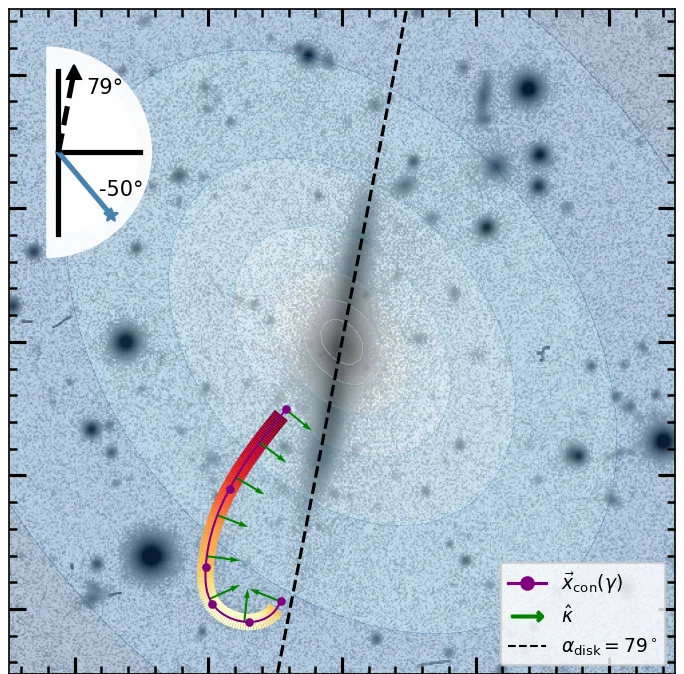
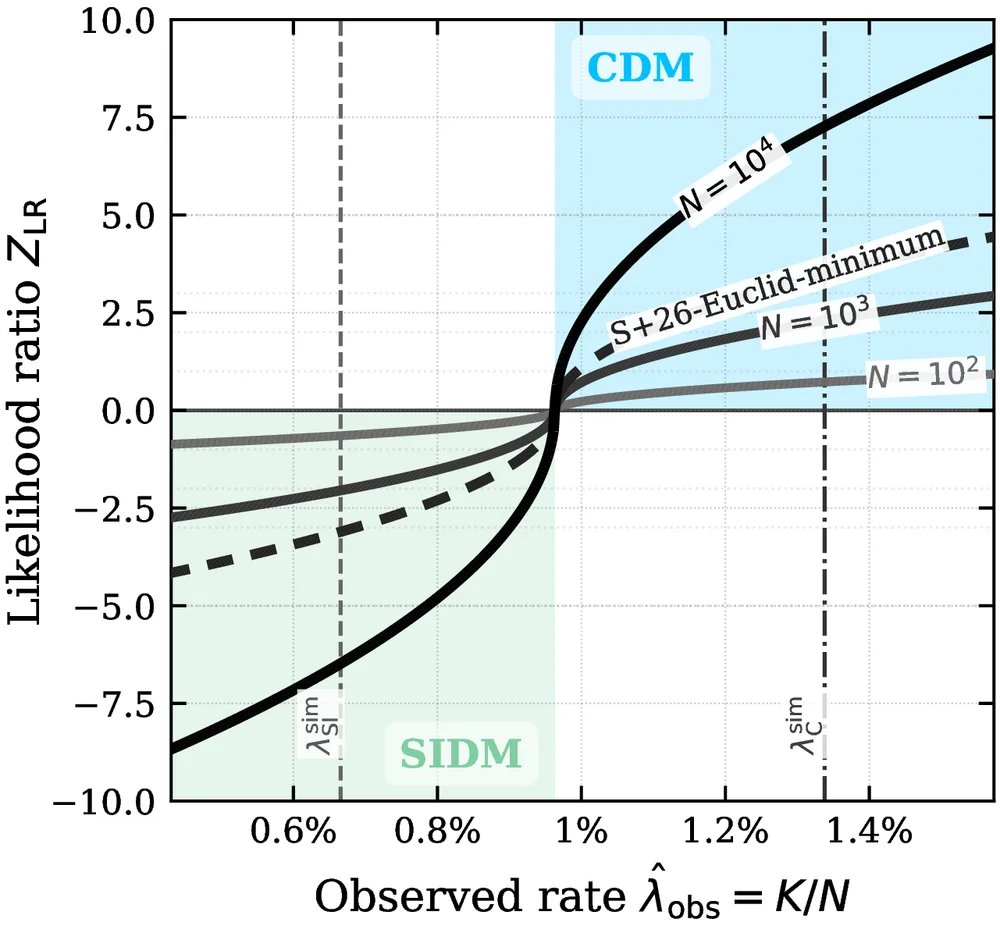
Potamides measured halo shapes from the projected tracks of 15 streams around nearby galaxies, and Potamides Software runs that inference in minutes on a laptop. Euclid Extragalactic Streams took the method to more distant galaxies, combining streams around 13 galaxies in Euclid’s first data release into one halo-shape measurement — the first analysis of streams at those distances, and the first to combine several streams. Larger samples allow a simpler test. In a spherical halo, a stream cannot curve away from its host galaxy’s centre in projection; in a flattened or triaxial halo, it can. When Streams Curve Away shows that how often streams curve this way, counted across the roughly 10,000 that Euclid, Rubin and Roman should find, can distinguish cold from self-interacting dark matter at up to 5σ.
‹ ›
The Astrophysical Journal 1010, 120 ApJ 1010, 120 · 2026 · S. Wu‡ , N. Starkman , et al.S. Wu‡ , N. Starkman , S. Pearson , et al.S. Wu‡ , N. Starkman , S. Pearson , J. Nibauer , J. Miro-Carretero , D. Martinez-Delgado · The Astrophysical Journal 1010, 120 ApJ 1010, 120 · 2026
The Astrophysical Journal 1010, 120 ApJ 1010, 120 · 2026
Potamides constrains the projected flattening and orientation of dark matter halos from the curvature of 15 streams in the Stellar Stream Legacy Survey.
Potamides constrains the projected flattening and orientation of dark matter halos from the curvature of 15 streams in the Stellar Stream Legacy Survey. Streams with edge-on loops or sharp turns constrain a halo most, and great-circle-like ones barely at all. Three of the streams hint that the stellar disk shapes the inner gravitational field. Led by Sirui Wu.
Journal of Open Source Software 11, 10712 JOSS 11, 10712 · 2026 · S. Wu‡ , N. Starkman , et al.S. Wu‡ , N. Starkman , J. Nibauer , et al.S. Wu‡ , N. Starkman , J. Nibauer , S. Pearson · Journal of Open Source Software 11, 10712 JOSS 11, 10712 · 2026
Journal of Open Source Software 11, 10712 JOSS 11, 10712 · 2026
Potamides is a JAX package that infers a galaxy’s mass distribution from the shapes of its stellar streams.
Potamides is a JAX package that infers a galaxy’s mass distribution from the shapes of its stellar streams. Rather than simulating a stream for every trial potential, it fits the observed track with splines and compares its curvature directly to the potential’s accelerations. It covers the pipeline from annotating streams to evaluating likelihoods. Led by Sirui Wu.
The Astrophysical Journal ApJ · 2026 submitted · N. Starkman , J. Nibauer , et al.N. Starkman , J. Nibauer , S. Pearson , et al.N. Starkman , J. Nibauer , S. Pearson , S. Wu‡ , L. Necib · The Astrophysical Journal ApJ · 2026 submitted
The Astrophysical Journal ApJ · 2026 submitted
How often stellar streams curve away from their host galaxy’s center can tell cold from self-interacting dark matter at up to 5σ, with catalogs the size Euclid, Rubin and Roman will provide.
How often stellar streams curve away from their host galaxy’s center can tell cold from self-interacting dark matter at up to 5σ, with catalogs the size Euclid, Rubin and Roman will provide. In a spherical halo a stream cannot curve this way in projection; in a triaxial halo, which cold dark matter predicts, it can. The test needs only the stream’s projected track and the host’s center: no distances, velocities or model of the stream’s progenitor.
Astronomy & Astrophysics A&A · 2026 submitted · Euclid Collaboration, N. Starkman , J. Nibauer , et al. Euclid Collaboration, N. Starkman , J. Nibauer , S. Pearson , et al. Euclid Collaboration, N. Starkman , J. Nibauer , S. Pearson , S. Wu‡ , M. Walmsley , L. Necib , J. Bovy , F. R. Marleau , et al. · Astronomy & Astrophysics A&A · 2026 submitted
Astronomy & Astrophysics A&A · 2026 submitted
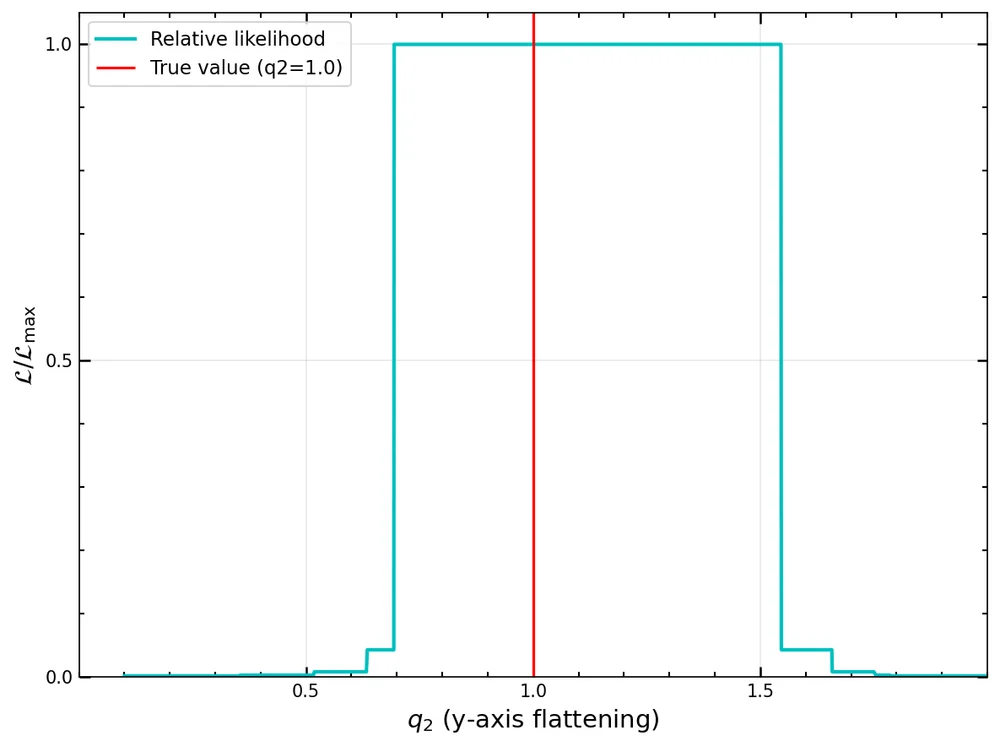
Stellar streams around 13 galaxies in Euclid’s first quick data release give a joint measurement of their dark matter halos’ shape: consistent with spherical, with a mild preference for flattening, q = 0.95 (+0.05, −0.10), in line with ΛCDM.
Stellar streams around 13 galaxies in Euclid’s first quick data release give a joint measurement of their dark matter halos’ shape: consistent with spherical, with a mild preference for flattening, q = 0.95 (+0.05, −0.10), in line with ΛCDM. A stream’s shape on the sky constrains the shape and center of its host’s halo, complementing weak lensing. These galaxies are seen up to about 4 billion years in the past, and Euclid is expected to find thousands more streams.
Monthly Notices of the Royal Astronomical Society MNRAS · 2018 · P. Li , … , N. Starkman , et al.P. Li , … , N. Starkman , et al.P. Li , F. Lelli , S. S. McGaugh , N. Starkman , J. M. Schombert · Monthly Notices of the Royal Astronomical Society MNRAS · 2018
Monthly Notices of the Royal Astronomical Society MNRAS · 2018
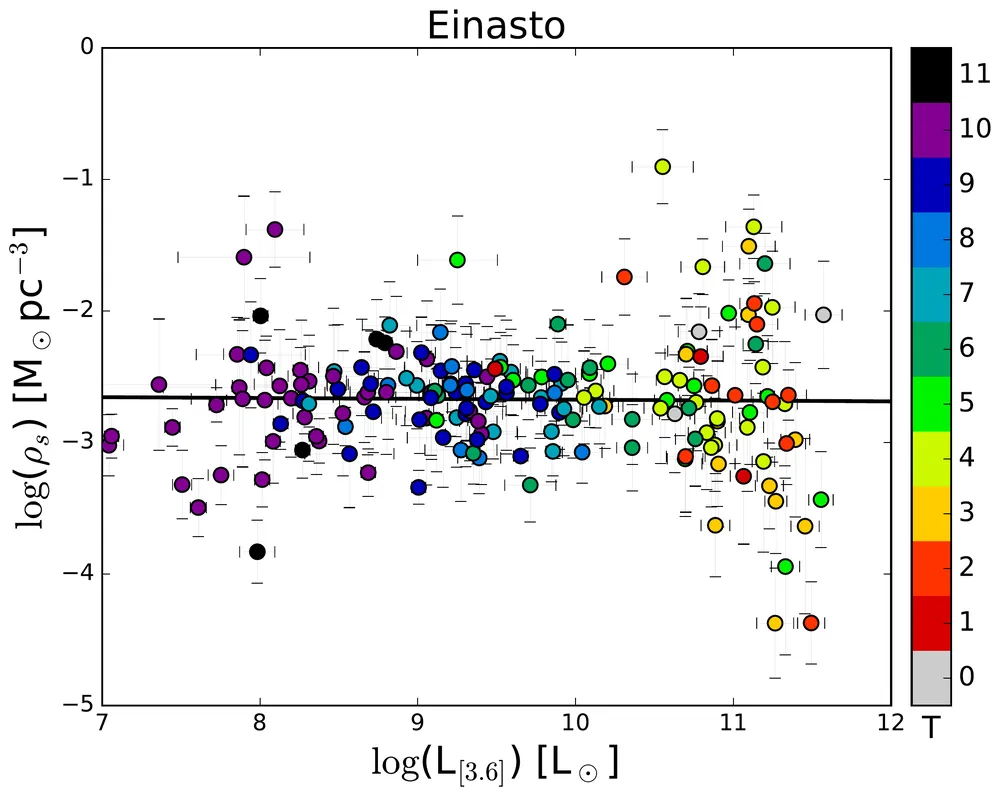
Fits to the rotation curves of 175 SPARC galaxies show that bigger galaxies have bigger dark-matter haloes, but the haloes’ typical density stays about the same.
Fits to the rotation curves of 175 SPARC galaxies show that bigger galaxies have bigger dark-matter haloes, but the haloes’ typical density stays about the same. That holds across galaxies that differ a hundred-thousand-fold in brightness, and it constrains how haloes grow along with the galaxies inside them.
Monthly Notices of the Royal Astronomical Society 480, 2292–2301 MNRAS 480, 2292–2301 · 2018 · N. Starkman , F. Lelli , et al.N. Starkman , F. Lelli , S. S. McGaugh , et al.N. Starkman , F. Lelli , S. S. McGaugh , J. Schombert · Monthly Notices of the Royal Astronomical Society 480, 2292–2301 MNRAS 480, 2292–2301 · 2018
Monthly Notices of the Royal Astronomical Society 480, 2292–2301 MNRAS 480, 2292–2301 · 2018
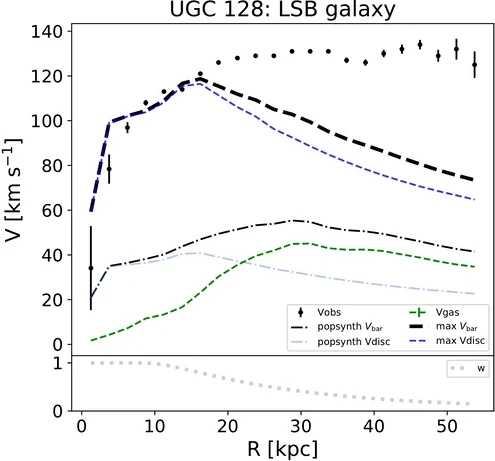
A new algorithm measures how close 153 SPARC galaxies come to a “maximum disc”, in which the stars supply as much of the rotation as they can.
A new algorithm measures how close 153 SPARC galaxies come to a “maximum disc”, in which the stars supply as much of the rotation as they can. The term had been used for decades without a precise definition. Bright galaxies come close to a maximum disc; faint ones cannot, because their stars would have to be unrealistically heavy for their light.
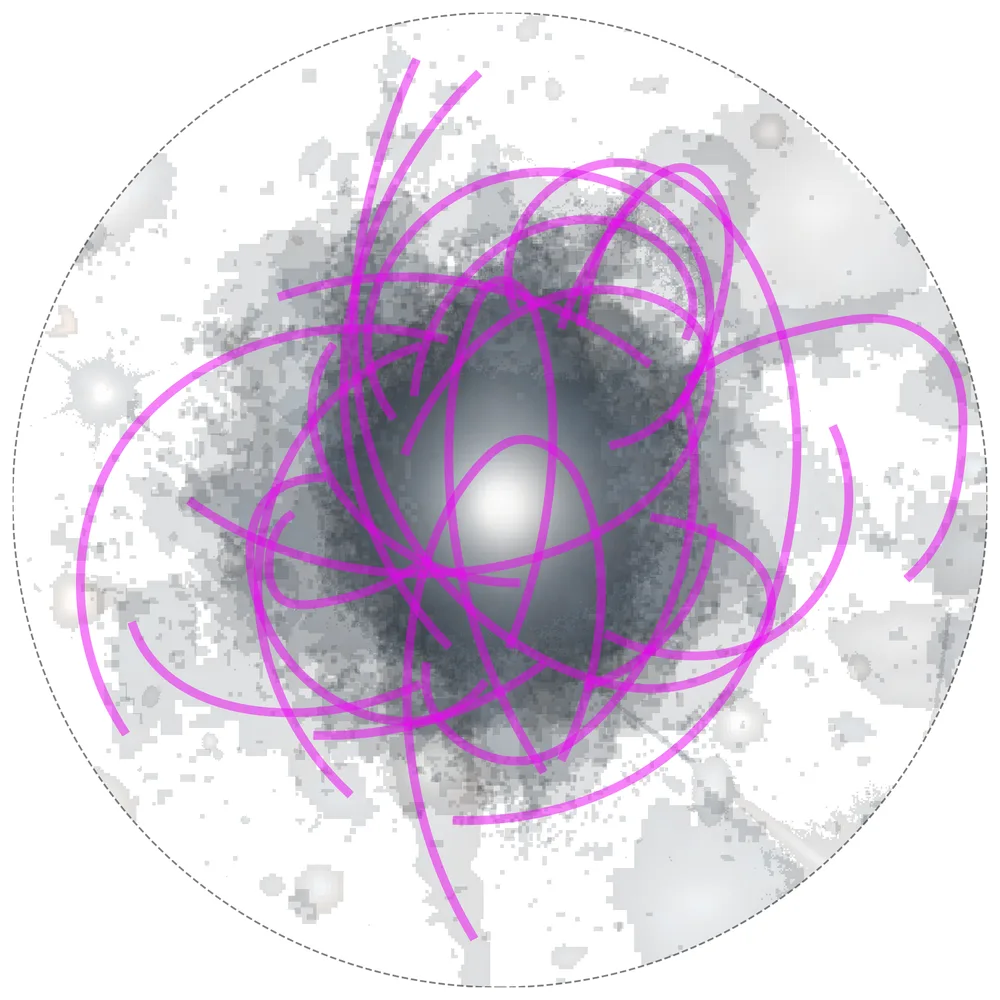
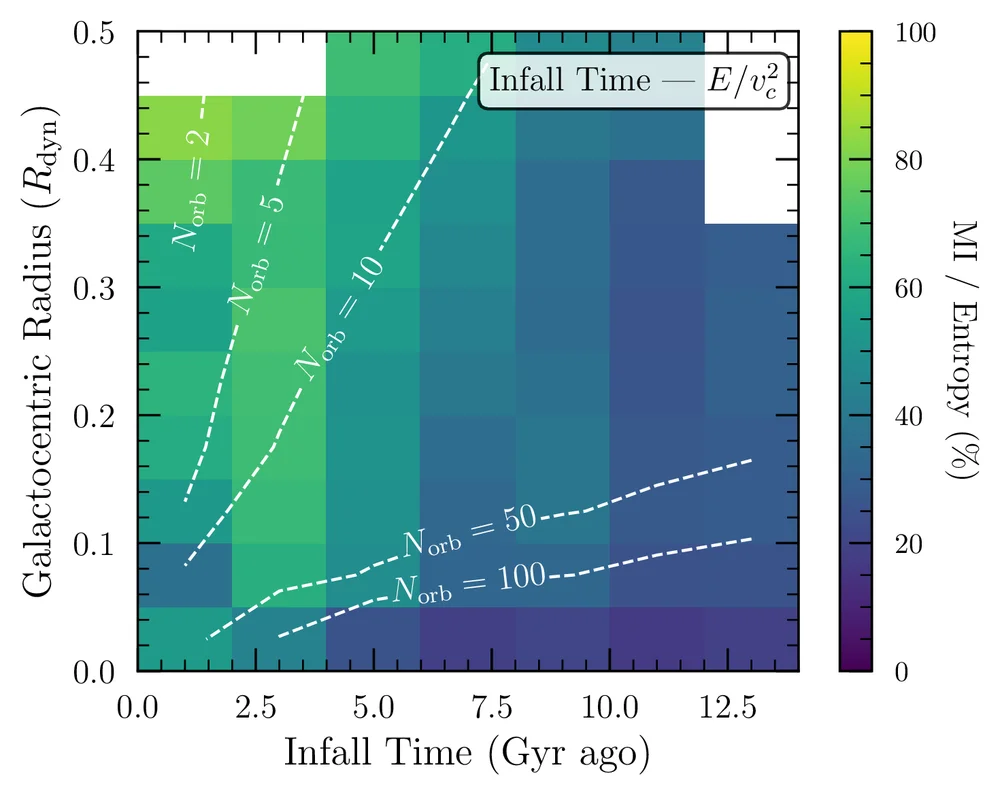
Galactic Stars that arrive in the Milky Way in the same merger are gradually mixed into the rest of the Galaxy, and the record of how it was assembled fades. Galactic Amnesia measures how quickly: radial velocities lose a merger’s mass and timing within about 5 billion years, but orbital energies keep it for more than 10 billion, provided we know the Galaxy’s gravitational potential. Stellar streams have not yet mixed. Their stars were stripped from one cluster and still lie along nearly a single orbit, so one snapshot shows a path that a single star would take hundreds of millions of years to travel. Extended Pal 5 nearly doubled the known length of Palomar 5’s leading tail. Stream Members Only infers a stream’s track, width and density together with which stars belong to it; other groups now use its GD-1 member catalogue to measure the Galaxy’s acceleration field and dark matter substructure. On the Fast Track measures a stream’s path in about a second, without assuming a model of the Milky Way.
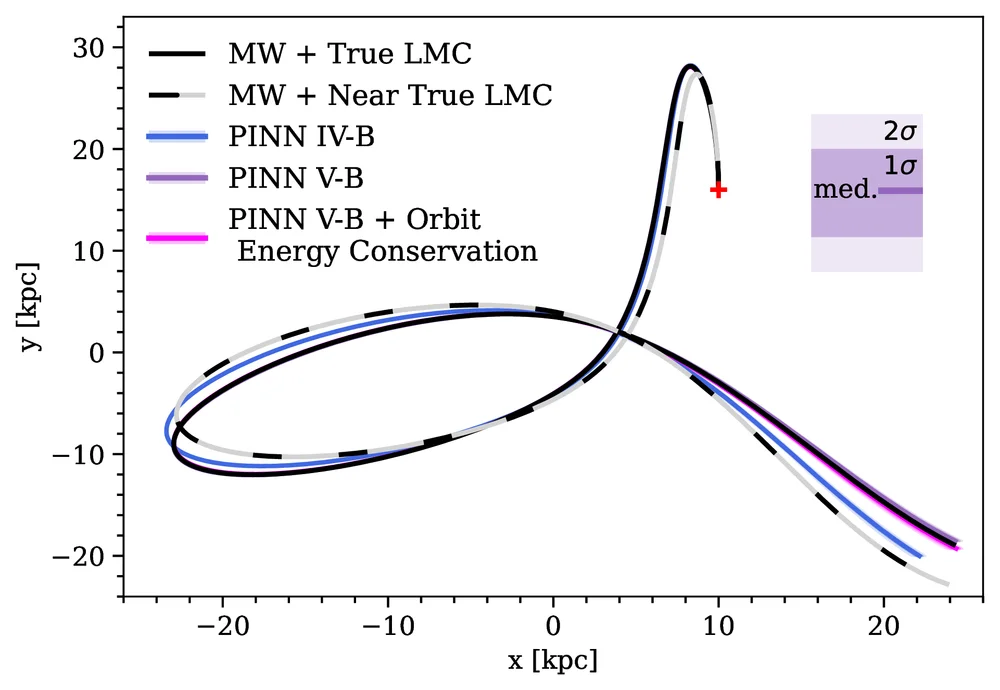
Streams measure dark matter on two scales: the Galaxy’s overall potential, which sets their orbits, and small dark matter clumps (subhaloes), which disturb them. StreamSculptor finds that GD-1 may have been hit by up to a hundred subhaloes too small to form stars, leaving its stars moving about three times more randomly than in an undisturbed stream, as cold dark matter predicts. Galactic PINNs learns the potential directly from measured accelerations; on simulated Milky Ways it recovers the effects of the Galactic bar and the Large Magellanic Cloud even when the starting model includes neither.
‹ ›
The Astrophysical Journal ApJ · 2026 submitted · C. Myers† , N. Starkman , et al.C. Myers† , N. Starkman , L. Necib C. Myers† , N. Starkman , L. Necib · The Astrophysical Journal ApJ · 2026 submitted
The Astrophysical Journal ApJ · 2026 submitted
A physics-informed neural network learns only the corrections to an analytic galactic potential, reaching sub-percent acceleration errors while staying interpretable.
A physics-informed neural network learns only the corrections to an analytic galactic potential, reaching sub-percent acceleration errors while staying interpretable. Its orbits are more faithful than the analytic model’s alone, and Bayesian and time-dependent versions add uncertainties and follow a potential as it changes. Led by undergraduate Charlotte Myers; code in galactoPINNs , first shown at NeurIPS 2025 .
arXiv:2605.04138· 2026 submitted · L. Necib , … , N. Starkman , et al.L. Necib , … , N. Starkman , et al.L. Necib , D. Folsom , E. Y. Davies , N. Starkman , A. Thoyas · arXiv:2605.04138· 2026 submitted
arXiv:2605.04138· 2026 submitted
In 98 simulated Milky Ways, a merger’s imprint on stellar orbital energy lasts more than 10 Gyr, while its imprint on radial velocity fades within about 5 Gyr.
In 98 simulated Milky Ways, a merger’s imprint on stellar orbital energy lasts more than 10 Gyr, while its imprint on radial velocity fades within about 5 Gyr. Orbits mix the stars a merger brings in, so the record of how a galaxy was assembled fades with time. Reading it from energies requires knowing the Milky Way’s gravitational potential.
The Astrophysical Journal 983, 68 ApJ 983, 68 · 2025 · J. Nibauer , … , N. Starkman , et al.J. Nibauer , … , N. Starkman , et al.J. Nibauer , A. Bonaca , D. N. Spergel , A. M. Price-Whelan , J. E. Greene , N. Starkman , K. V. Johnston · The Astrophysical Journal 983, 68 ApJ 983, 68 · 2025
The Astrophysical Journal 983, 68 ApJ 983, 68 · 2025
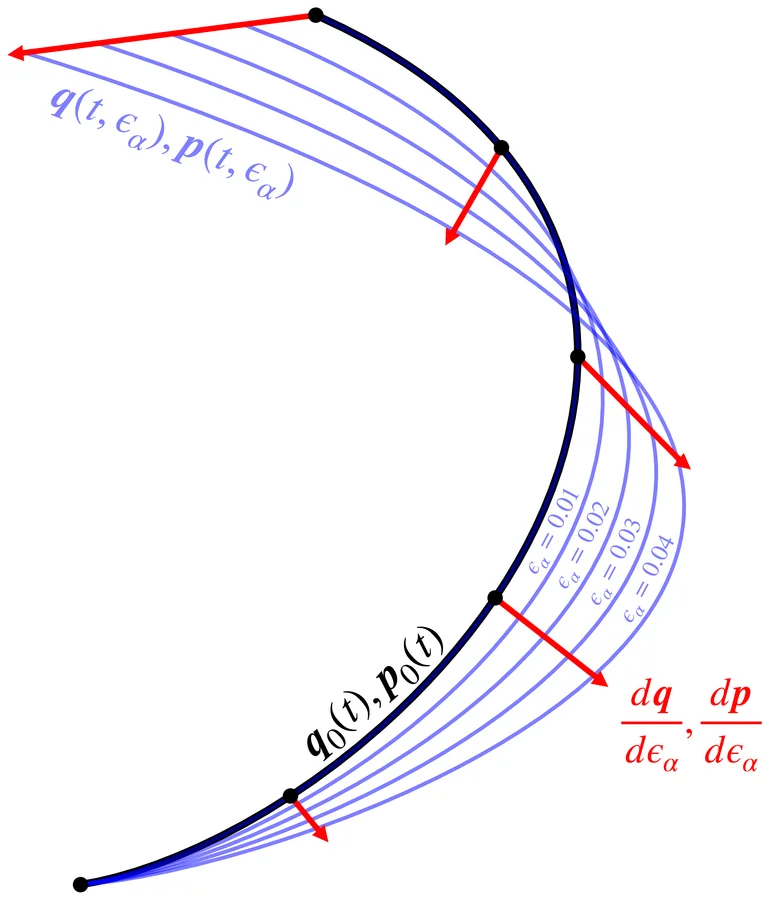
StreamSculptor uses Hamiltonian perturbation theory to model stellar streams in time-dependent potentials, fast enough to include the LMC, the Galactic bar and the dozens of subhalo impacts expected for streams like GD-1 and Pal 5.
StreamSculptor uses Hamiltonian perturbation theory to model stellar streams in time-dependent potentials, fast enough to include the LMC, the Galactic bar and the dozens of subhalo impacts expected for streams like GD-1 and Pal 5. Because a stream’s velocity dispersion depends on the impacts it has suffered, the model connects whole stream populations directly to dark matter properties. Led by Jacob Nibauer.
The Astrophysical Journal 980, 253 ApJ 980, 253 · 2025 · N. Starkman , J. Nibauer , et al.N. Starkman , J. Nibauer , J. Bovy , et al.N. Starkman , J. Nibauer , J. Bovy , J. Webb , K. Tavangar , A. Price-Whelan , A. Bonaca · The Astrophysical Journal 980, 253 ApJ 980, 253 · 2025
The Astrophysical Journal 980, 253 ApJ 980, 253 · 2025
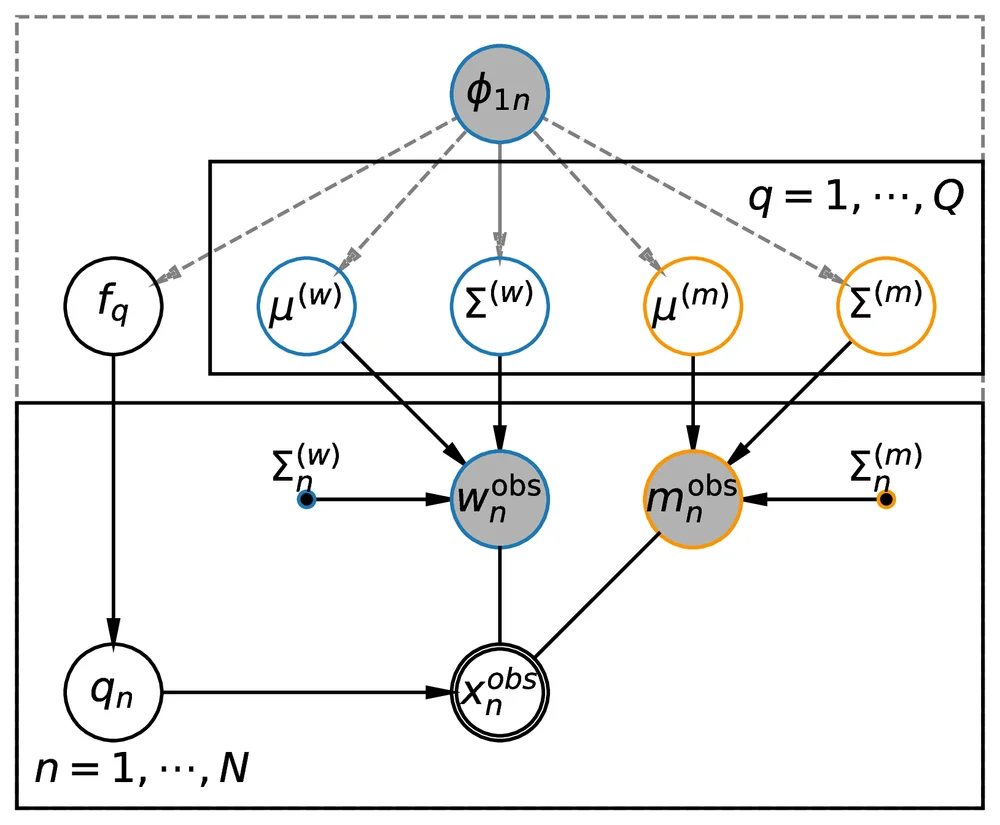
Mixture density networks model a stellar stream’s track, width, density and kinematics together with each star’s probability of belonging to it.
Mixture density networks model a stellar stream’s track, width, density and kinematics together with each star’s probability of belonging to it. The method uses all the available astrometry and photometry, models the background with normalizing flows, and works even where phase-space data are incomplete. Applied to GD-1 and Palomar 5, it produced public catalogs of stellar membership probabilities.
Monthly Notices of the Royal Astronomical Society 522, 5022–5036 MNRAS 522, 5022–5036 · 2023 · N. Starkman , J. Bovy , et al.N. Starkman , J. Bovy , J. Webb , et al.N. Starkman , J. Bovy , J. Webb , D. Calvetti , E. Somersalo · Monthly Notices of the Royal Astronomical Society 522, 5022–5036 MNRAS 522, 5022–5036 · 2023
Monthly Notices of the Royal Astronomical Society 522, 5022–5036 MNRAS 522, 5022–5036 · 2023
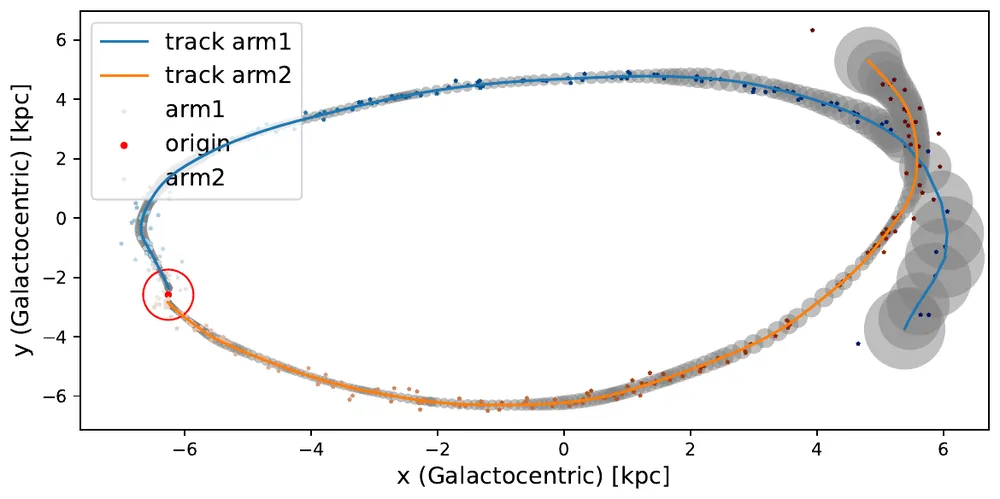
This method traces a stellar stream’s path and its uncertainty without assuming any model of the Galaxy.
This method traces a stellar stream’s path and its uncertainty without assuming any model of the Galaxy. It first puts the stars in order along the stream, then fits the path through them. It works on simulated streams and on real ones like Palomar 5 and GD-1, and is available as the Python package TrackStream.
Monthly Notices of the Royal Astronomical Society MNRAS · 2020 · N. Starkman , J. Bovy , et al.N. Starkman , J. Bovy , J. Webb N. Starkman , J. Bovy , J. Webb · Monthly Notices of the Royal Astronomical Society MNRAS · 2020
Monthly Notices of the Royal Astronomical Society MNRAS · 2020
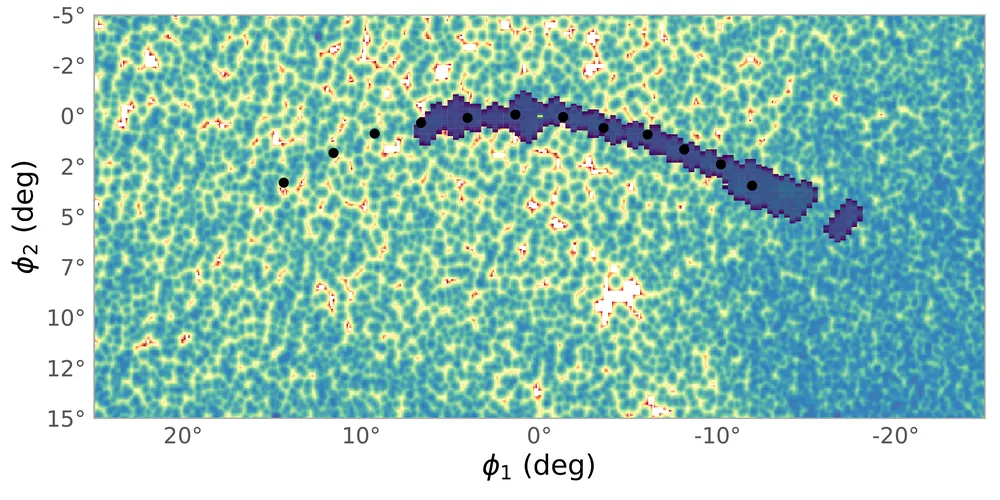
Gaia data show that Palomar 5’s leading tail runs about 7° further than was known, making the stream about 30° long.
Gaia data show that Palomar 5’s leading tail runs about 7° further than was known, making the stream about 30° long. Palomar 5 is a star cluster being pulled apart by the Milky Way, and its two tails trace the Galaxy’s gravity. The tails come out roughly equal in length, which limits how much the Galactic bar can have shortened one of them.
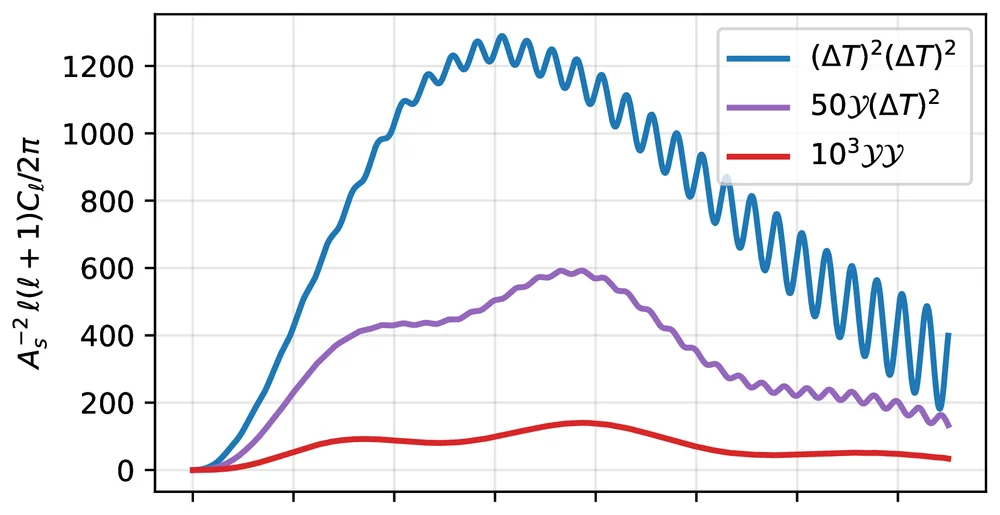
Cosmic Microwave Background The cosmic microwave background is almost a perfect blackbody. Its small departures from that spectrum, called spectral distortions, carry information the temperature map does not. In CMB Spectrum Distortions we calculate a distortion that standard cosmology must produce. As the Universe became transparent, photons diffused between hotter and colder regions, mixing blackbodies of slightly different temperatures. The mixing makes a faint Compton y-distortion that is strongest where the mixed temperatures differ most, so it correlates with the square of the temperature map. ACT and SPT should already be able to detect that correlation, at a signal-to-noise of about 12, which would be a new test of early-Universe physics.
‹ ›
Monthly Notices of the Royal Astronomical Society 529, 2274–2288 MNRAS 529, 2274–2288 · 2024 · N. Starkman , G. Starkman , et al.N. Starkman , G. Starkman , A. Kosowsky N. Starkman , G. Starkman , A. Kosowsky · Monthly Notices of the Royal Astronomical Society 529, 2274–2288 MNRAS 529, 2274–2288 · 2024
Monthly Notices of the Royal Astronomical Society 529, 2274–2288 MNRAS 529, 2274–2288 · 2024
Standard cosmology predicts a small Compton y-distortion in the CMB spectrum that correlates with the squared temperature fluctuations.
Standard cosmology predicts a small Compton y-distortion in the CMB spectrum that correlates with the squared temperature fluctuations. It forms as the universe becomes transparent: the photons reaching us from any one direction last scattered off regions at slightly different temperatures, and their blackbodies blend. ACT and SPT should already detect the correlation, at a forecast signal-to-noise of about 12, and CMB-S4 could make it a new cosmological probe.
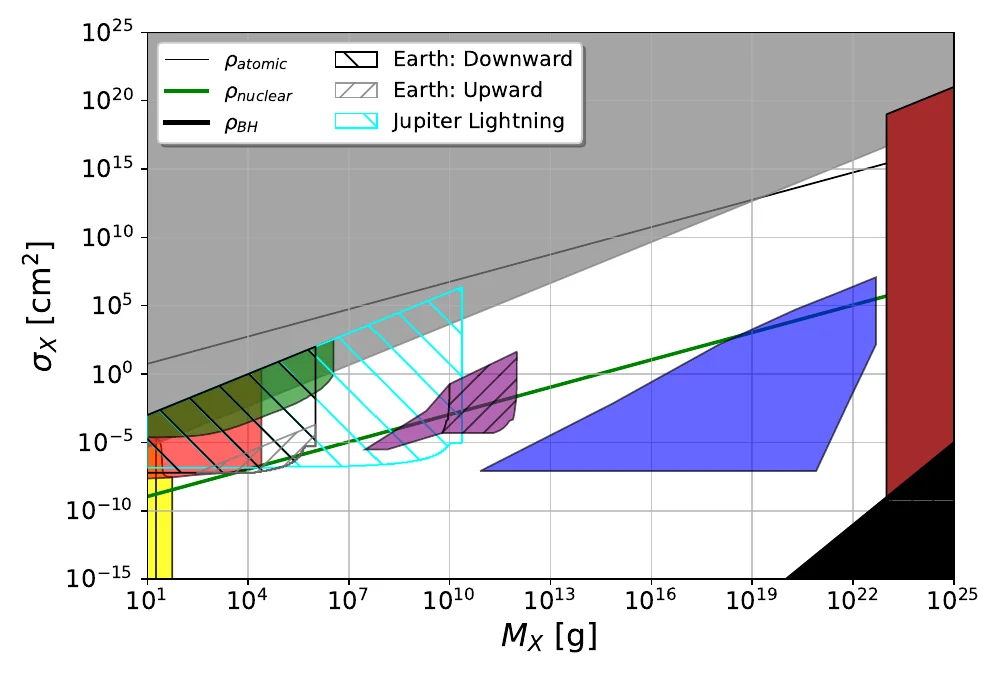
Dark Matter Direct Detection Direct-detection experiments put a shielded detector underground and wait for a dark matter particle to scatter off it. If dark matter instead comes as macroscopic objects, far heavier and therefore far rarer than particle candidates, no laboratory detector is large enough to expect a single hit. In Macro Lightning we use the atmosphere as the detector. A macro passing through a thunderstorm would leave a long, straight channel of ionized air that could seed a lightning bolt as straight as a ruler. Ordinary lightning is jagged: the chance of it running even ten steps that straight is about 3 in 10 trillion. A search for straight lightning, on Earth or on Jupiter, would make thunderstorms into planet-sized dark matter detectors.
‹ ›
Physical Review D 103, 063024 PRD 103, 063024 · 2020 · N. Starkman , H. Winch , et al.N. Starkman , H. Winch , J. S. Sidhu , et al.N. Starkman , H. Winch , J. S. Sidhu , G. Starkman · Physical Review D 103, 063024 PRD 103, 063024 · 2020
Physical Review D 103, 063024 PRD 103, 063024 · 2020
If dark matter comes as large objects — macros — rather than tiny particles, a macro crossing a thunderstorm could trigger a perfectly straight lightning bolt.
If dark matter comes as large objects — macros — rather than tiny particles, a macro crossing a thunderstorm could trigger a perfectly straight lightning bolt. Ordinary lightning is jagged, so searching for straight bolts, on Earth or on Jupiter, can constrain macro dark matter.
Conferences Every talk, poster and workshop, and where it happened:
Equal Earth projection Online — 10 talks Cleveland, OH, USA — 8 talks Toronto, ON, Canada — 8 talks Cambridge, MA, USA — 4 talks Copenhagen, Denmark — 3 talks Atlanta, GA, USA — 2 talks Jesi, Italy — 2 talks Lausanne, Switzerland — 2 talks New York, NY, USA — 2 talks Paris, France — 2 talks A Coruña, Spain — 1 talk Boston, MA, USA — 1 talk College Station, TX, USA — 1 talk Córdoba, Spain — 1 talk Durham, UK — 1 talk Hamilton, ON, Canada — 1 talk Ithaca, NY, USA — 1 talk Pasadena, CA, USA — 1 talk Pittsburgh, PA, USA — 1 talk Portoferraio, Italy — 1 talk Portsmouth, UK — 1 talk Potsdam, Germany — 1 talk Princeton, NJ, USA — 1 talk Reykjavik, Iceland — 1 talk Rochester, NY, USA — 1 talk Santa Cruz, CA, USA — 1 talk Seattle, WA, USA — 1 talk Valencia, Spain — 1 talk + − ⤢
Show Everywhere A Coruña, Spain (1) Atlanta, GA, USA (2) Boston, MA, USA (1) Cambridge, MA, USA (4) Cleveland, OH, USA (8) College Station, TX, USA (1) Copenhagen, Denmark (3) Córdoba, Spain (1) Durham, UK (1) Hamilton, ON, Canada (1) Ithaca, NY, USA (1) Jesi, Italy (2) Lausanne, Switzerland (2) New York, NY, USA (2) Online (10) Paris, France (2) Pasadena, CA, USA (1) Pittsburgh, PA, USA (1) Portoferraio, Italy (1) Portsmouth, UK (1) Potsdam, Germany (1) Princeton, NJ, USA (1) Reykjavik, Iceland (1) Rochester, NY, USA (1) Santa Cruz, CA, USA (1) Seattle, WA, USA (1) Toronto, ON, Canada (8) Valencia, Spain (1)
Aug 2026 New Frontiers in Cosmology (Talk) contributed “Energy Structures of Extragalactic Stellar Streams Reveal Dark Matter Halos” May 2025 DDA #56 (Poster) contributed “Extra-Galactic Gravity using Streams (EGGS) from Euclid's Zoo(niverse)” May 2025 Division of Dynamical Astronomy #56 organised Mar 2022 Astropy Core Developer Conference (Talk) attended “The future of interoperability with Python's Protocols” Jan 2026 Gaia Hackathon organised Sep 2025 MKI Journal Club (Talk) contributed “Euclid: The Geometry of Dark Matter Halos from Extragalactic Streams” Jan 2025 Gaia Hackathon organised May 2023 Astropy Conference (Talk) contributed “An Interoperable Future with Astropy” Feb 2026 CWRU Seminar invited talk “Computationally Unscrambling EGGS (Extra-Galactic Gravity from Streams)” Oct 2024 CWRU Seminar invited talk “Stream Members Only: Data-Driven Characterization of Stellar Streams for Inference on the Galactic Potential” Jul 2020 Kaplan cosmology course (Talk) contributed Paid lecturer in Kaplan Cosmology course at Case Western Reserve University Jun 2018 The Standard Model at 50 Years attended A Celebratory Symposium for the Standard Model Conference Volunteer May 2018 CWRU SOURCE Intersections (Poster) contributed “A new algorithm to quantify maximal disks” Oct 2017 CWRU Physics Seminar (Talk) contributed “Understanding the Dark Matter distribution in galaxies using maximal disks” Aug 2017 CWRU Astronomy Summer Seminar (Talk) contributed “Understanding the Dark Matter distribution in galaxies using maximal disks” Jun 2017 Dwarf Galaxies on the Shoulders of Giants attended Workshop on topics related to dwarf galaxies and the dark matter problem Conference Volunteer Oct 2025 Texas A&M Seminar invited talk “The Geometry of Dark Matter Halos from Extragalactic Streams” Jun 2026 DARK Seminar (Talk) contributed “Energy Structures of Extragalactic Stellar Streams Reveal Dark Matter Halos” Oct 2025 DARK seminar invited talk “The Geometry of Dark Matter Halos from Extragalactic Streams” Mar 2025 DARK seminar invited talk “Bayesian models for detecting streams in LSST data” Oct 2025 IAUS 403 (Talk) contributed “Euclid: The Geometry of Dark Matter Halos from Extragalactic Streams” Aug 2024 Streams 24: The theory edition (Talk) contributed “From JAX to Galax, a new generation of stellar stream tools” — Using ML to select stellar stream members Jul 2019 ComSciCon Canada 2019 attended Selected participant at Canada’s first national science communication workshop for graduate students Aug 2016 Cornell CLASSE Summer Seminar (Talk) contributed “Coherent curvature radiation in a neutron star’s monopolar magnetic field” Aug 2026 Astrophysics and Space Science in Marche III: Big Bang, Big Stars, Big Computers organised Aug 2026 Marche III: Big Bang, Big Stars, Big Computers invited talk “Energy Structures of Extragalactic Stellar Streams Reveal Dark Matter Halos” Jun 2026 EAS 26-S10 invited talk “The Geometry of Dark Matter Halos from Extragalactic Streams” May 2025 Euclid LU-SWG (Talk) contributed “Extra-Galactic Gravity using Streams (EGGS) from Euclid's Zoo(niverse)” Sep 2025 CCA Software seminar invited talk “unxt, coordinax, and software development in JAX” Oct 2024 JAXtronomy Workshop organised Sep 2026 Astropy 2026 Conference organised Moderated online discussion and helped moderate the AI sessions. Feb 2023 The Future of Astrophysical Data Infrastructure attended Mar 2022 Oxford Physics Colloquium invited talk “Straight Lightning as a Signature of Macroscopic Dark Matter” — Invited Colloquium Talk Jul 2021 ComSciCon GTA 2021 organised A workshop series for graduate students on science communication skills Jun 2021 AAS 2021 (Talk) contributed “Astropy Tutorials on Units & Constants, Coordinates, and Cosmology” May 2021 CASCA AGM (Poster) contributed “Straight Lightning as a Signature of Macroscopic Dark Matter” May 2021 CASCA AGM (Poster) contributed “Stellar Stream Track Reconstruction, with Errors” Aug 2020 Johns Hopkins University Physics Journal Club invited talk “Straight Lightning as a Signature of Macroscopic Dark Matter” Aug 2020 STScI 2020 The Local Group: Assembly and Evolution Symposium (Poster) contributed “Constraints on Milky Way Halo Triaxiality from Palomar 5” Jul 2020 ComSciCon GTA 2020 organised Toronto’s first ComSciCon Sep 2019 5th Gaia Challenge Conference (Talk) contributed “Using Manifold Learning Techniques to Identify Stream Progenitors” Sep 2019 5th Gaia Challenge Conference (Talk) contributed “Extending the Pal5 Stream Detection Limits” Oct 2022 CATS-2022 (Workshop) contributed “Streams22: A workshop for assembling a Community Atlas of Tidal Streams” Oct 2023 DESC sprint week contributed Sep 2025 Cosmology 2025 (Talk) contributed “Euclid: The Geometry of Dark Matter Halos from Extragalactic Streams” Dec 2019 30th Texas Symposium On Relativistic Astrophysics (Talk) contributed “Resolving the Recombination Visibility Function Width Tension” — Awarded best graduate student presentation Mar 2023 IAUS379: Dynamical Masses of Local Group Galaxies (Poster) contributed “Stellar Stream Track Reconstruction, with Errors” Sep 2025 Princeton Thunch Seminar invited talk “Euclid: The Geometry of Dark Matter Halos from Extragalactic Streams” Aug 2017 Origins Cruise to the British Isles, Iceland and Norway (Talk) invited talk “The Life and Death of the Universe: An Overview Lecture on Cosmology” Aug 2019 Great Lakes Cosmology Workshop (Talk) contributed “Parameterizing the recombination visibility function” Jun 2025 Astropy Coordination Meeting organised Jan 2023 AAS 2023 (Talk) contributed “Astropy Tutorials on Units & Constants” Jul 2026 Near Field Cosmology in the Era of Big Data (Talk) contributed “Energy Structures of Extragalactic Stellar Streams Reveal Dark Matter Halos” Jan 2026 York Seminar (Talk) contributed “Euclid: The Geometry of Dark Matter Halos from Extragalactic Streams” May 2024 Division on Dynamical Astronomy #55 (Talk) contributed “Stream Members Only: Data-Driven Characterization of Stellar Streams” May 2024 Globular Clusters and Their Tidal Tails (Talk) contributed “From JAX to Galax” May 2024 Globular Clusters and Their Tidal Tails (Talk) contributed “Stream Members Only: Data-Driven Characterization of Stellar Streams” Jan 2023 CITA Seminar invited talk “Astropy Cosmology: the Present and the Expanding Future” May 2021 Stellar Stats Workshop (Talk) contributed “Stellar Stream Track Reconstruction, with Errors” Oct 2019 .Astronomy 11 organised Led a workshop on scientific plotting Nov 2025 TeVPA invited talk “The Geometry of Dark Matter Halos from Extragalactic Streams”